Lil’ Inspirations – Washed Up

WASHED UP

GALLERY

DSCN1841

Image 3 of 23

HISTORY

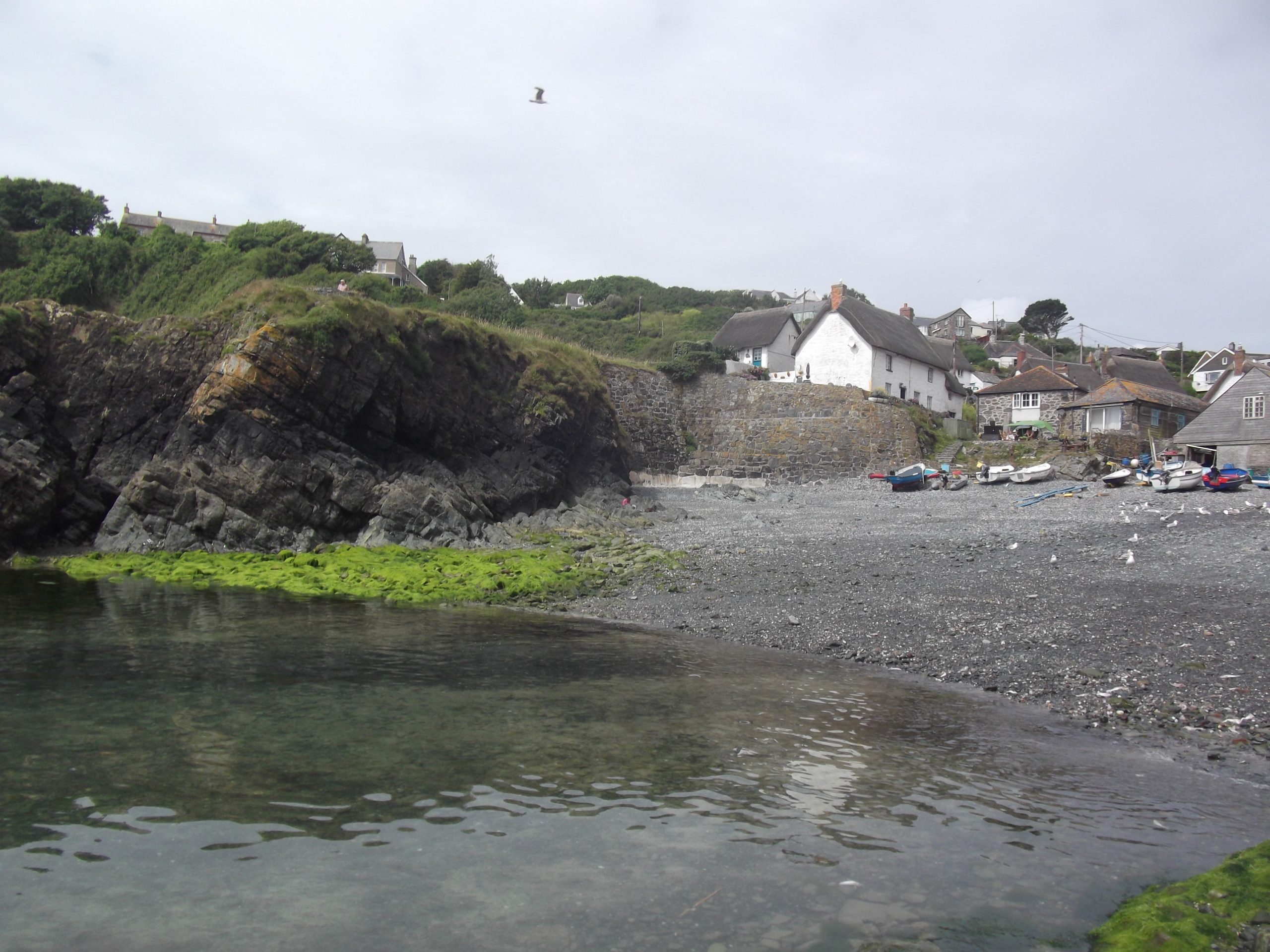
Cadgwith Cove is a historic fishing village on the Lizard Peninsula in Cornwall, England, with roots stretching back to medieval times. Originally recorded as Porthcaswith (and Porthkajwydh in Cornish), the name translates to “cove of the thicket” or “battle of trees,” reflecting the densely wooded valley that once surrounded it.
It began in the Middle Ages as a collection of fish cellars where local farmers supplemented their livelihoods with fishing. By the 16th century, it evolved into a permanent settlement with stone, cob, and thatched cottages lining the steep valley and shingle cove. During the 17th and 18th centuries, Cadgwith—like much of the rugged Cornish coast—became a notorious hotbed for smuggling. Smugglers used the cove’s hidden caves, narrow alleyways, and local knowledge to land and store contraband such as brandy, tea, and tobacco. Records note that by 1778 it was common for inhabitants to secrete goods for major smuggling rings, a practice that persisted well into the 1820s until coastguards (such as Lieutenant Roberts in 1825) were more heavily deployed.


For centuries, the backbone of Cadgwith’s economy was the pilchard industry. Lookout men known as huers stood on the headlands shouting “Hevva, Hevva!” (“Here they are!”) to direct large seine boats and nets to enclose massive shoals. The industry reached a peak in 1904, when a record 1,798,000 pilchards were landed over four days. Overfishing and shifting sea temperatures eventually caused the pilchard shoals to decline by the 1950s. Lifeboat Station: The Cadgwith Cove Lifeboat Station operated from 1867 to 1963, saving numerous lives along the hazardous Cornish coast. The old boathouse is now used by the Cadgwith Pilot Gig Club. St Mary’s Church was built in 1895 as a fishermen’s chapel out of corrugated iron, it features local history and memorials. The Cadgwith Cove Inn has served the community for roughly 400 years, and former pilchard cellars now house local art galleries and crab. Today, Cadgwith remains one of the last true working “artisan” fishing coves in Cornwall. Rather than large pilchard fleets, local fishermen operate cooperatively to land brown crab, spider crab, lobster, and wet fish.

MUSIC

😀
0
😍
0
😢
0
😡
0
👍
0
👎
0

Leave a Reply

Your email address will not be published. Required fields are marked *